Showing posts with label product/market fit. Show all posts

Wednesday, July 05, 2017

WTF is PMF? (part 2 of 2)

In the first part of this post, I looked at what some of the most knowledgeable people in the industry said about Product/Market Fit (PMF) and how they try to define and measure it. While everybody seems to agree on the broad concept of PMF there is (unsurprisingly) no consensus on how exactly it can be defined and measured, and some people set the bar much higher than others. For example, according to Brad Feld you find PMF somewhere between $100k and $1M in MRR, while others argue that you can have PMF with much lower revenues.

In this part I’d like to talk a bit about my view on PMF and how we try to detect it when we look at SaaS startups at Point Nine. Here’s my favorite definition of PMF, inspired by many of the people mentioned in the first part of the post:

Product/Market Fit means having a product that solves a problem for a significant number of independent customers.

Note that this definition intentionally doesn’t say anything about market size. Lots of companies have PMF for a very small market, but addressing a small market is not a reason to deny a company its PMF.

If we talk about PMF for “VC cases”, i.e. the type of company venture capital investors are looking for, I would adjust the definition as follows:

Product/Market Fit means having a product that solves an important problem – without custom work and better than existing solutions – for a significant number of independent customers in a large market.

The next step in getting to a solid definition would be to define the pieces that this definition includes: How “important” is important enough, and how can it be measured? How much “better” is better enough, and how can it be measured? And so on.

There are no clear answers to these questions and – sorry – I don’t think there is a razor-sharp way of defining and measuring PMF. Some companies clearly have PMF, some clearly don’t. Others are somewhere in the middle – they have indications of PMF but it’s not clear if they will ever get to strong PMF. Most seed investments that we’re considering fall into the last bucket.

Here’s an overview of the most important factors that we’re looking at when we try to assess the degree of PMF of a SaaS company. In isolation, none of these factors can tell you if you have PMF or not. But taken together, it can hopefully give you at least a good indication:


This concludes my mini-series on Product/Market Fit (at least for now). Let me know if you have any feedback!

___________________________

1) For more background on the concept of rabbit/deer/elephant hunters, check out this post.
2) Take a look at this post to read more about "expected usage frequency".
3) This is from Sean Ellis’ test for PMF. More on this here.


Wednesday, June 28, 2017

WTF is PMF? (part 1 of 2)

I’ve been fascinated by the concept of Product/Market Fit for quite some time. The reason why it’s such an interesting and important concept is that getting to Product/Market Fit (PMF) marks a critical juncture in a company’s lifecycle. At least in theory, the life of a company can be divided into a “pre PMF” phase and a “post PMF” phase, with each of the two phases having very different objectives and requiring very different strategies. As Marc Andreessen famously said, “when you are before PMF, focus obsessively on getting to PMF”. Once you have PMF, you can start to focus on hiring, getting more customers, finding customer acquisition channels, optimizing pricing, and so on. In reality, there’s usually not a sharp line of demarcation that separates the “before” from the “after”. Rather, companies typically increase their level of PMF gradually.

The problem with PMF is that it’s hard to precisely define and even harder to measure. So difficult, in fact, that I’ve heard several people resort to the “I know it when I see it” phrase (famously used by a Supreme Court justice to define pornopgraphy). Think about it. We have the concept of a demarcation line which calls for different strategies “before” and “after”, but we don’t seem to have a precise definition of that concept, nor the tools to measure whether a company is “before” or “after”! To make things worse, according to data from a Startup Genome Report “premature scaling” (i.e. spending significant amounts of money on growth before you find PMF) is the #1 reason why startups fail!

Let’s look at what some of the smartest people in the industry have said and written about PMF.

1. What is Product/Market Fit?


  • Paul Graham apparently said that PMF simply means “making stuff that people want” (I couldn’t find the original quote but saw it in this presentation).
  • Marc Andreessen got more precise, saying that PMF means “being in a good market with a product that can satisfy that market”.
  • Michael Skok added the important element of the “Minimum Viable Segment” in this article, pointing out that “your product isn’t going to fit the entire market from day one. Minimum Viable Segment (MVS) is about focusing on a market segment of potential customers who have the same needs to which you can align.”
  • My dear colleague Clément Vouillon added another dimension – distribution – and defined PMF like this: “It happens when the product (a set of features that have a clear value proposition) resonates with customers (which are of a certain type and have defined needs) that you know how to reach and convert (through marketing and sales).”
  • Andrew Chen has another interesting twist: PMF is “when people who know they want your product are happy with what you’re offering”.
  • Last but not least, according to Eric Ries “The term product/market fit describes ‘the moment when a startup finally finds a widespread set of customers that resonate with its product”, and Andy Rachleff said: “You know you have fit if your product grows exponentially with no marketing.”

2. Is Product/Market Fit a discrete event, or is there a gradual development towards PMF?


  • In his excellent talk at the great SaaStock conference in Dublin last fall, Peter Reinhardt, co-founder & CEO of Segment, explained how Segment, after struggling for a long time, suddenly got to PMF when they put up a landing page for what used to be a little side project. According to Peter, “product market fit is not vague, positive conversations with customers. It's not glimmers of false hope around some random positive interaction. What it actually feels like is a landmine going off”.
  • According to Brad Feld and Ben Horowitz, Segment’s experience is the exception to the rule, though. According to Brad, PMF is something that you find somewhere between $100k and $1M MRR, and Ben has called PMF as a “discrete, big bang event” a “myth”.

3. How can Product/Market Fit be measured?


  • As mentioned in the beginning, a lot of people would say you can’t measure PMF and that you “know it when you see it”. Sean Jacobsohn of Norwest Venture Partners took up the challenge and developed a 5-question quiz that you can use to rate your level of PMF. I like his approach a lot and turned the quiz into a little Typeform some time ago.
“I ask existing users of a product how they would feel if they could no longer use the product. In my experience, achieving product/market fit requires at least 40% of users saying they would be “very disappointed” without your product. Admittedly this threshold is a bit arbitrary, but I defined it after comparing results across nearly 100 startups. Those that struggle for traction are always under 40%, while most that gain strong traction exceed 40%.” 
(taken from “The Startup Pyramid”)
I’m fascinated by Sean’s approach because it’s the most quantifiable way to detect PMF that I’ve seen so far. The question is whether the 40% threshold, which as Sean admits is a bit arbitrary, will continue to hold true with bigger sample sizes. I’m also wondering to what extent this “test” can be skewed by the type of users that you happened to attract. Nevertheless, it’s impressive that there seems to be a strong pattern among almost 100 startups.
  • Andrew Chen offers a few examples of what PMF looks like. For a SaaS company, he mentions a few indicators, including these:
    • 5% conversion rate from free to paid
    • less than 2% monthly churn
    • clear path to $100k MRR


In the second part of this post (which I’ll hopefully finish in a few days) I’ll talk a bit about my personal view on PMF and how we try to detect it when we look at SaaS startups at Point Nine. Don’t expect too much wisdom though, unsurprisingly we don’t have the ultimate answer to the PMF conundrum!

[Update: Here is part 2.]

Saturday, November 30, 2013

The 8th DO for SaaS startups - Stay on top of your KPIs

“What gets measured gets done” – it seems like the source of this quote, often attributed to management expert Peter Drucker, isn’t certain, but its meaning is clear and very relevant for every SaaS founder. If you want to make sure that you make best use of your scarce resources, you need to have a clear understanding of your objectives and the KPIs that measure your progress towards those objectives.

Depending on the stage that you’re in you’ll want to focus on different metrics. I’ve tried to illustrate this in the following diagram:
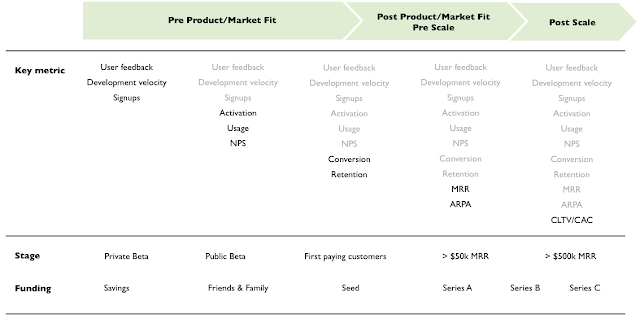
(click image for larger version)

As you can see, I segmented the company lifecycle into three major phases: pre product/market fit, post product/market fit but pre-scale, and post-scale (being fully aware that there is no distinct definition of “product/market fit” and “scale” and that the transition from one phase to the next one is a gradual one). At the bottom I noted what these phases usually mean in terms of the stage of your product and company and which funding level it typically corresponds with. Note that the x-axis is not a true-to-scale representation of time elapsed. For a true-to-scale representation I would have to add much more space between the Series A and the Series B and between the Series B and the Series C.

The key message of the chart is that in the beginning you can focus on a small set of metrics, but as time goes by and you’re making progress you need to add additional KPIs to your cockpit.

Let’s have a closer look at each of the three phases.

Pre product/market fit

I’ve written about it before in my posts about sales and unscalable hacks: In the very beginning, when you’re in the process of finishing the first version of your product and trying to get the first customers, you shouldn’t worry too much about metrics. Firstly there just aren’t many metrics to keep an eye on yet. Secondly you should be obsessively focused on getting to product/market fit (Marc Andreessen’s words), and that means you should spend your time talking to customers and developing the product.

That said, the following metrics are relevant in the pre product/market fit phase:

  • User feedback: Most of the user feedback that you collect in this phase is qualitative rather than quantitative, but if you talk to a larger number of potential users you might also be able to add some quantitative elements. For example, you could ask users to rate your prototype and see if that rating goes up over time.
  • Development velocity: I don’t know if (or how strictly) you should use a software development methodology like Scrum, which allows you to nicely visualize your development velocity, in the very early days, when you’re maybe just two developers – I would be very interested in your thoughts on that question. At any rate, however, I think it’s a good idea to break down your project into a larger number of smaller pieces, features or “story points” early on. This will help you in getting an understanding of your development speed, which later on will become more and more important.
  • Waiting list signups: When you put up a landing page to collect email addresses for your waiting list, track how many signups you’re getting. Driving signups probably isn’t a key priority for you at this stage but it’s an indication of interest in your product and hey, you’ll still have some space on your Geckoboard which you can fill with a nice chart! :)

Once you let potential customers try your product, the real fun begins. At that point, you should track signups and some indicators for activation and usage, which, for obvious reasons, are precursors to your ultimate goal, paying customers. What the right indicators for activation are depends on the type of your product. It could be a profile completion and the setup of a customized pipeline in case of a CRM application, the installation of a tracking snippet for a Web analytics product or… you get the idea. Similarly, usage metrics are highly specific to your application, so think about what the right events and parameters are in your particular case and make sure that you instrument your application accordingly. If your solution is a little more enterprisey and you’re working with a higher-touch sales model you may also want to track qualified leads along with trial signups.

In order to succeed you need happy customers who do free marketing for you, otherwise customer acquisition will always be an uphill battle. Therefore you should also consider regular Net Promoter Score (NPS) surveys. If you’re looking for the best survey tool, I have a tip for you.

Post product/market fit, pre scale

As you’re slowly but surely getting to product/market fit and starting to get the first paying customers (yay!), your trial-to-paid conversion rate becomes one of the most vital metrics. It’s hard to give you a benchmark, since your conversion rate not only depends on the quality of your product and the onboarding experience but also on many other things such as leads quality, pricing and many other factors. With that caveat in mind, the typical range that we’re seeing is between 5% and 25%.

Equally important is your retention, usually tracked by measuring churn (the inverse of retention), since your CLTV (customer lifetime value) is a direct function of how much you charge your customers and how long they stay on board. As a very rough rule of thumb you should try to get your churn rate to 1.5-3% per month.

Make sure to track churn not only on an account basis but also on an MRR basis. Your MRR-based churn rate will hopefully be significantly lower than your account-based churn rate, since smaller customers tend to have a higher churn rate and because your loyal customers will hopefully pay you more and more over time. Also, make sure that you avoid SaaS Metrics Worst Practice #8, mixing up monthly and yearly plans. Finally, if you want to get a good estimate of your customer lifetime, take a look at retention on a cohort basis.

If you don’t have a KPI dashboard yet that gives you an at-a-glance look at your key metrics, now is the time to build one. Here’s a template that I’ve created, along with some additional notes.

As you’re moving on, arguably the most important metric becomes MRR, and specifically net new MRR that you’re adding each month. Net new MRR is calculated using this simple formula:


Also keep an eye on your ARPA (average revenue per account). It’s an important metric at all times for obvious reasons, but as you’re nearing the next phase it’s becoming even more important.

Post scale

When you’ve reached a certain level of success, say you’re at around $500k MRR, the biggest challenge (besides growing a bigger organization and mastering all kinds of growing pains of course) is to find ways to profitably acquire customers at a much higher scale. By this time you’ve picked all the low-hanging fruits, and you may have maxed out what you can reasonably spend on AdWords to buy traffic and leads.

Therefore you’ll have to focus on the relationship between your CLTV and your CACs (customer acquisition costs), your CLTV/CAC ratio, which measures the ROI on your sales and marketing investments. Another way to look at it is your CACs payback time, which tells you how many months of subscription revenue it takes to recoup customer acquisition costs. If I had to choose I’d pick this one, since CLTV is always an estimate which can be more or less accurate.

A few last points:

  • Many startups struggle to get all these numbers together because different numbers are collected in different systems (e.g. Web analytics software, billing systems, self-made databases,...), which often leads to inconsistencies. I don’t have a simple and general advice for this issue, I might address it in another post.
  • If you’re not sure which metrics to track, e.g. which events in your application, err on the side of tracking too much data even if you have no immediate use for it. You never know if it becomes useful in the future, and the costs for tracking large amounts of data are no longer very high nowadays.
  • If you want to read more about SaaS metrics, I highly recommend David Skok’s blog and Joel York’s blog, as well as Jason M. Lemkin and Tomasz Tunguz.

That was it for the 8th DO for SaaS startups – questions, comments and suggestions are as always very welcome!

[Update 01/17/2015: There's a new company called ChartMogul (which we invested in) which makes it easy to get a real-time dashboard of your SaaS metrics. Check it out!]


Monday, September 16, 2013

The 7th DO for SaaS startups – Build a repeatable, profitable sales process

The last post in my series on DOs and DON'Ts for early-stage startups was about lead generation. The next logical step is sales, and so I want to write about what you can do to convert as many of those leads into paying customers.

7th DO for SaaS startups
Build a repeatable, profitable sales process

Sales is a very different animal depending on the stage of your company, the market segment you're going after and on whether we're talking about inbound sales or outbound sales. For all the differences, though, the goal is always to create a scalable process which allows you to acquire customers for a small fraction of their CLTV. As a rule of thumb, you should aspire a payback time of 6-9 months, meaning that you spend 6-9 months' worth of subscription revenue to acquire a customer. It really is just a rule of thumb though, since depending on the customer lifetime and various other factors, you may want to accept a significantly longer payback period.

To achieve a payback period in that neighborhood you have three options:
  1. If your ARPA is around $20-50 per customer per month, you need to be able to generate a large amount of leads for little money and convert them with little to no human interaction (self-service with no/low touch sales)
  2. In order to support an inside sales force you need customers who pay you around $100 per month, preferably significantly more (often called "transactional sales").
  3. If you need a field sales force to sell your product, assume that your ARPA needs to be at least $3000 per customer per month if not higher (enterprise sales).
Most people would argue that you need much higher prices to make inside sales work (including Jason M. Lemkin, who says you need at least $300/m), but several of our portfolio companies have shown that due to a combination of high conversion rates, fast sales cycles and sales people in countries where salary levels are 50-80% lower compared to Silicon Valley, you can use inside sales people to profitably acquire customers at much lower price points.

So – take the specific numbers with a grain of salt as they are highly dependent on a variety of individual factors. The important message is that your customer lifetime value defines what you can spend on customer acquisition. If you don't keep that in mind you'll end up in what Joel York, who created a nice visualization of the different models, calls the "startup graveyard".

In line with the theme of this series I'm going to focus primarily on the self-service and transactional models and want to break down my tips & tricks into three parts based on the stage of your company. I'm going to call them "pre product/market fit", "pre scale" and "post scale" (being well aware that the transitions between these phases are gradual). I'll focus on inbound sales in this post and will follow up with one on outbound sales shortly.

Pre product/market fit
  • In the beginning, while you're still trying to figure out product/market fit, spend as much time with potential customers as possible. Don't consider the time spent with customers a sales expense – it's an essential investment that you need to make in order to solve a real problem of real people.
  • Don't worry about scalability yet. In this phase it's perfectly fine to do things that are completely unscalable. As I wrote before, a good "unscalable hack" for SaaS startups is to spend huge amounts of time with early users.
  • Don't worry about processes or tools, don't even worry about metrics (if you know me a bit you know that you won't hear me say this often!). Be "obsessively focused on getting to product/market fit", as Marc Andreessen put it.

Post product/market fit, pre scale

When you've found product/market fit and start to get more and more signups every month, some of the things that you did in the previous phase start to not work any more. As long as you get 50 signups a month you can still talk to every trial customer. Once that number gets into the hundreds or thousands, you need to hire people and put some processes and tools in place.

So the goal of this phase is to maximize the conversion rate of a large and ever-increasing trial volume while keeping customer acquisition at an acceptable level and starting to get a sense for the scalability of various sales and marketing channels. With that in mind, here are some tips:
  • Set up an automated lifecycle email program to welcome new users, reach out to inactive users and follow-up with users towards the end of their free trial. Solutions like userfox (a portfolio company of ours) or Intercom make it easy.
  • Send personalized messages to as many trial users as possible. Use any piece of information that you can easily get e.g. by looking at the trial customer's website or the way he uses your software to add some personal touch. This job can be done by junior customer support or sales people. The idea is to make every trial customer feel important and show him that you care, but do it in a highly scalable way. 
  • Segment your trial users based on factors like potential account size, activity and brand and use this information to prioritize the queue for your inside sales people. A lot of this can be automated e.g. by checking a trial customer's Alexa rank or Google Page Rank to get an indication of the company's size. Also take a look at Totango, which can help you identify your most valuable prospects. You can also use this information to assign different types of potential customers to different types of sales people (e.g. small businesses are assigned to junior customer care people, bigger ones are assigned to more senior Account Executives).
  • Set up a lead nurturing program for trial users who are only moderately interested in your product or don't have an immediate need for your product yet. Send them a newsletter, offer webinars, organize events... The goal is to provide them with valuable content and stay top of mind, so that when they eventually need a solution they'll think of  you.
  • Track everything and do lots and lots of tests. A/B test different messages, find out the best moments and triggers for your lifecycle emails, test in-app messaging... In short: Try lots of different things and measure what works best.
  • Avoid SaaS Metrics Worst Practice #3, which is to attribute all conversions to your sales team. To calculate the effectiveness and the ROI of your sales team you have to measure the conversion uplift relative to your unaided baseline conversion.  
  • You can still do things that you know won't scale, but you should know what these things are and leave this phase with an excellent understanding of your CACs at scale.

Post scale

In this phase you're going to double down on what you've found to be working in the previous phase. Sounds easy, but it of course comes with its own challenges: Hiring, onboarding and retaining the right people; continuing to fill the funnel with enough leads to keep your sales team busy; adapting processes  and tools for a much larger sales team. At this point it's primarily a management challenge, and if you've come this far without hiring a seasoned VP of Sales, now is the time to hire one. And since this series is geared towards early-stage SaaS startups I'll leave it with this. :)